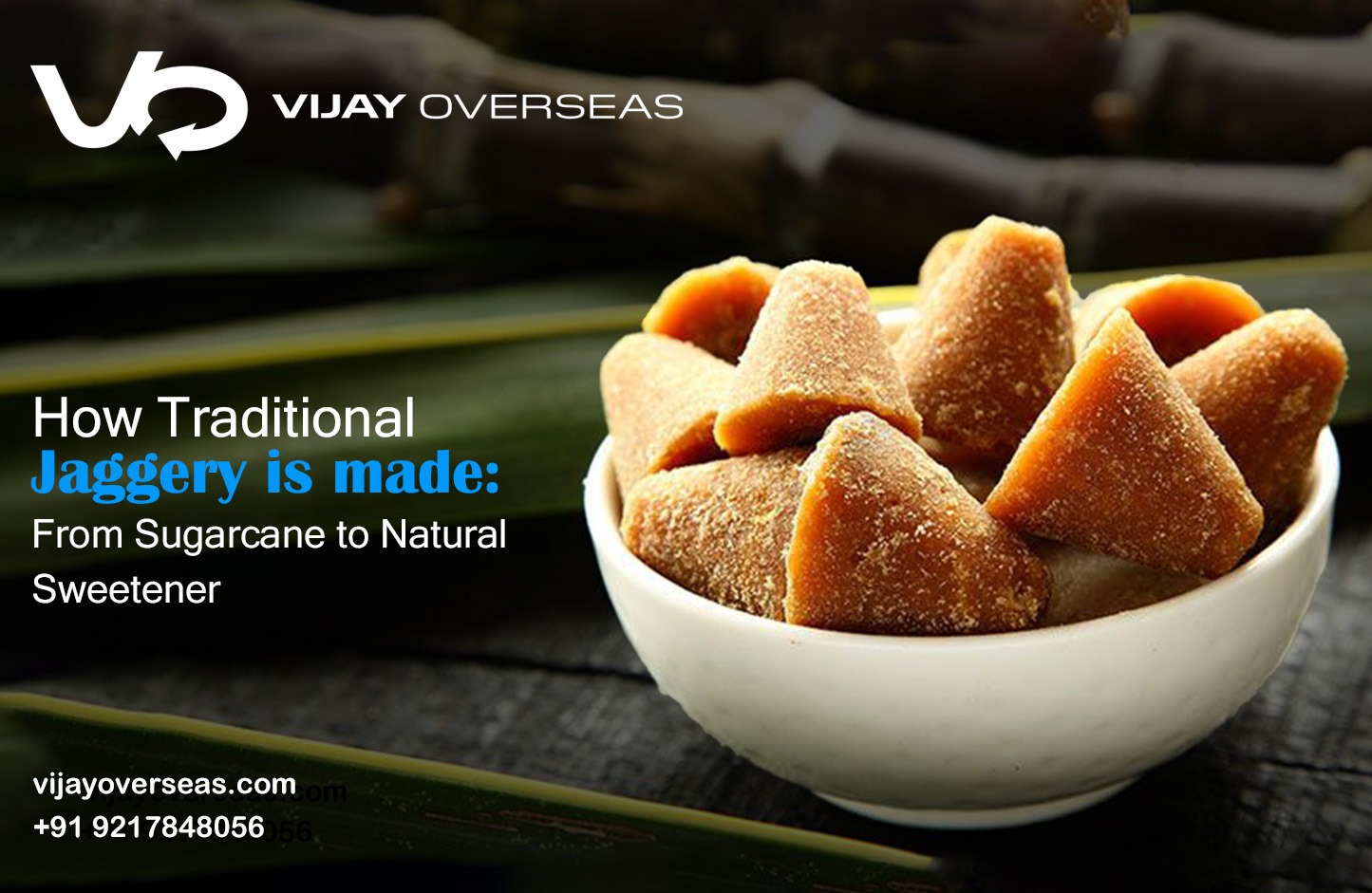
A traditional natural sweetener made by concentrating sugar can juice, jaggery has been used for long in Indian cooking. Before white sugar overtook the world, jaggery was made in simple, traditional ways that honoured nature, time and skill. Even now to-days traditional jaggery is still in vogue because of its genuineness, flavor and cultural aspects.
And when we know how traditional jaggery is made — from sugarcane to natural sweetener, it can be a source of pride for buyers and consumers as well as global importers who are willing to pay top dollars for the pure stuff. Unlike the industrial production of sugar, jaggery-making takes a slower, more natural path that conserves what you love about sugarcane.
- Harvesting Fresh Sugarcane
The process of making jaggery begins in the sugarcane fields themselves. Perfectly ripe sugarcane is harvested at the right time for maximum juice content and natural sweetness.
Freshness is critical. Sugar cane is normally processed soon after it is harvested to minimize fermentation and maintain quality. This kind of instant processing is one of the reasons why traditional jaggery retains its aroma and flavour.
- Crushing the Sugarcane
After the sugarcane is harvested, it is washed and pressed to obtain juice. In the olden days, they used the most basic of equipment – mechanical crushers run by electricity or diesel, but ancient extraction techniques were still practised.
The extracted sugarcane juice is:
- Greenish in colour
- Rich in natural sugars
- Loaded with plant based impurities waiting to be clarified
It is this raw juice, the Aakaljuice that forms the base of pure jaggery.
- Natural Clarification of Sugarcane Juice
Clarification is a most important step in the production of traditional jaggery.
The juice becomes clarified using both the chemical and natural clarification process.The traditional way of clarifying the jaggery is an honest, long procedure that does not involve any chemical agents. Plant based materials and natural settling methods assist in the removal of contaminants such as dust, fibres and soil particles.
This step ensures:
- Cleaner juice
- Better taste
- No chemical residues
Foam and impurities rising to the surface are skimmed off manually, making the operation simple and open.
- Slow Boiling in Open Pans
The clarified sugarcane juice is then poured into large, open iron pans. The juice is then gently boiled down by means of controlled heat.
This long, slow simmering is essential as:
- It also removes cold moisture, which can help to prevent bacteria and mould from developing.
- It thickens the juice gradually
- It acquires a typical brown color and pungent smell.
There are no shortcuts for cane that’s being made into safe sugar instead of industrial sugar. This will take a few hours depending the amount of magnets and temperature.
- Concentration and Consistency Check
The juice becomes thicker and darker as it continues to boil. Highly skilled workers keep a close eye on the texture, temperature and consistency.
Experience tells when this second stage is reached—when the liquid becomes a thick syrup that will harden on cooling. It is this judgment that has a direct impact upon:
- Texture
- Shelf stability
- Final product quality
Processes for jaggery-making have low level of automation and are based on human skills.
- Moulding and Shaping
When you have reached the desired consistency, take the thick jaggery syrup off heat and pour it into containers.
Jaggery can be formed into: According to use and demand, jaggery is made in the form of:
- Blocks
- Cubes
- Balls
- Slabs
This semi solid mass is then cooled and crushed to form jaggery powder.
By now the jaggery is hardening up naturally without agents.
- Cooling and Natural Hardening
The moulded jaggery is cooled at ambient temperature. It cools, gets solid and forms the max structure.
In conventional methods, there exists no artificial cooling or chemical hardening agents. Natural cooling ensures:
- Stable texture
- Authentic taste
- Retention of sugarcane character
The jaggery is ready for packing after it fully cools down.
- Sorting, Quality Checks, and Packaging
Jaggery blocks or powder are closely examined before packaging. Specifications Traditional producers and exporters look for:
- Uniformity
- Absence of foreign matter
- Proper hardness or granulation
- Moisture levels
Hygienic packaging becomes very crucial when it is intended for exports or bulk supply to prevent the jaggery from moisture and adulteration.
Contemporary exporters now marry both traditional manufacturing, with modern quality monitoring and packaging standards to ensure that the world outside Tanzania receives what it has come to expect.
- Jaggery of the Bygone Era and Its Significance Today
Even with all these technology, the traditional jaggery continues to be popular due to:
- Minimal processing
- Absence of chemicals
- Authentic flavour
- Cultural and culinary importance
Natural & Clean Label: With naturalness and clean label top of mind for global customers, traditionally-made jaggery is the ideal ingredient across many markets.
Vijay Overseas and Conventional Jaggery Manufacture
We source from reliable farmers who adhere to traditional chemical free jaggery making methods as well as meet strict modern hygiene and export norms.
Our focus includes:
- Sustainably sourced sugarcane
- Traditional boiling and processing methods
- No artificial additives or preservatives
- Generational continuity of quality for domestic and export market.
We take pride in our tradition and we take pride in providing the best jaggery both culturally and commercially.
Conclusion
Translating pappanchatti jaggery making is serendipity of nature, time and experience. From the fresh cane to slow boiling and natural molding, each process is exactly right for the genuine article.
Learning about the process can help buyers appreciate why old-fashioned jaggery differs from mechanized varieties, and how demand for this sweetener remains in markets worldwide.
🌿 On the lookout for naturally prepared, chemical-free jaggery?
Visit 👉 www.vijayoverseas.com
Or, explore our jaggery range, discover our sourcing, get in touch for bulk supply and export queries.