Tag: import and export

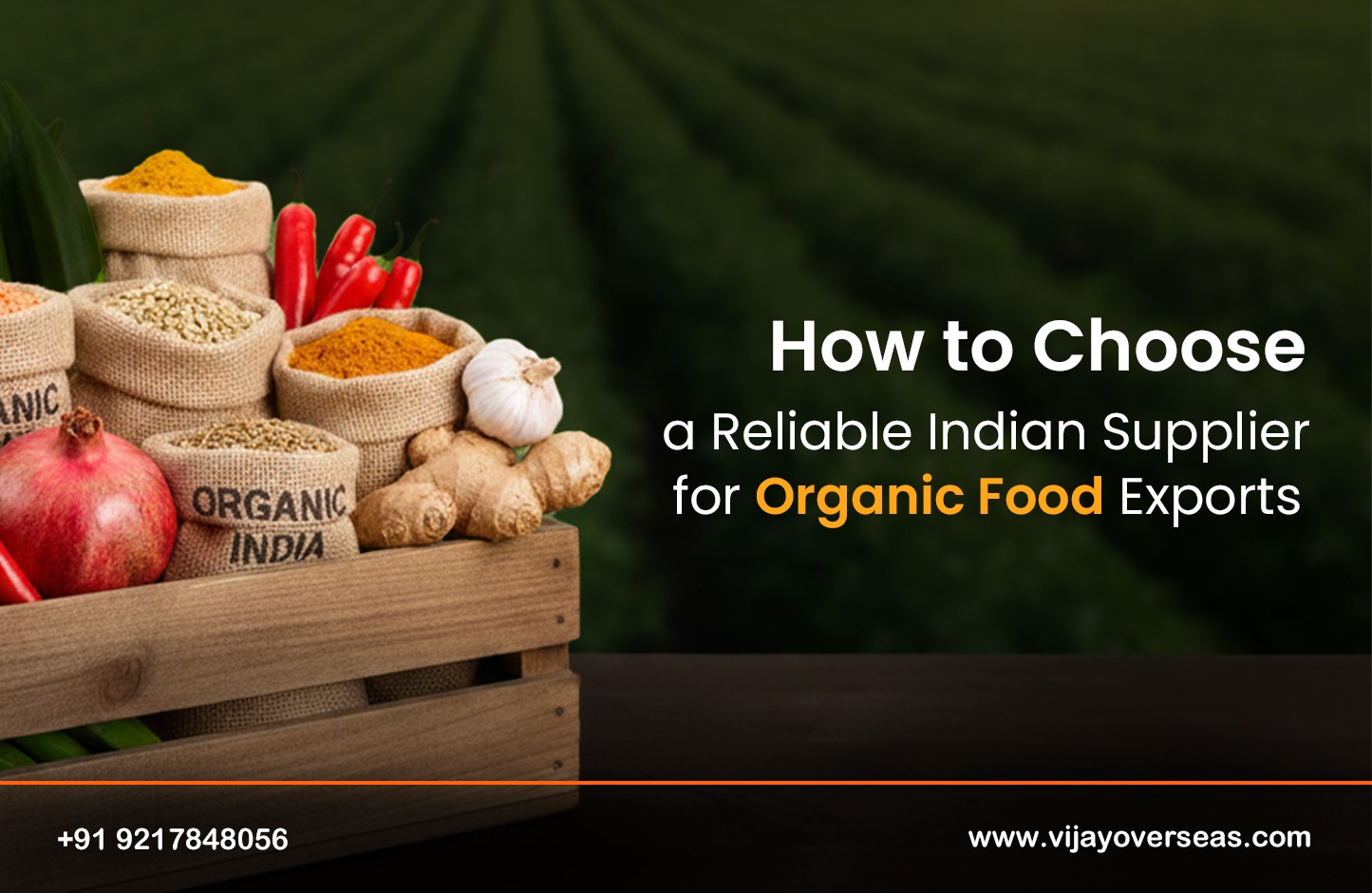
  • How to Choose a Reliable Indian Supplier for Organic Food Exports

    How to Choose a Reliable Indian Supplier for Organic Food Exports

    In recent years, India has become one of the most trusted sources globally for organic and natural food products — ranging from jaggery and spices to lentils, pulses and herbal produce. Amid increasing worldwide demand for clean-label foods, selecting the right Indian supplier is crucial to quality, compliance and business longevity.

    But not all exporters are held to the same standards.

    And if you’ve decided to source organic food from India, this guide will ensure that you select the right supplier who brings you reliability, consistency, transparency and export-ready quality.

    1. Verify Organic Certifications & Compliance

    The first step is to make sure that the company complies with respected organic standards.

    Look for certifications such as:

    ✔ India Organic / NPOP

    ✔ USDA Organic

    ✔ EU Organic Certification

    ✔ ISO Food safety or HACCP

    These certifications are also evidence that the supplier adhere to controlled farming, processing, and hygiene standards. Remember to ask for certificates copies and validity dates before you commit to a purchase of any sale.

    2. Evaluate Processing and Quality Control Standards

    A good supplier isn’t just anyone who supplies your raw materials, but someone who can manage the value chain from harvest to packaging with thorough quality control.

    Reliable exporters will have:

    · Clean and hygienic processing establishments

    • Batch testing procedures

    • Moisture & contamination control

    • Standardized grading and sorting

    Request photos, videos or audit reports of their facilities. This allows you to maintain consistent quality of food product throughout shipments.

    3. Check Packaging & Shelf-Life Management

    Organic export-grade foods need a pack that both keeps the contents fresh and meets international standards.

    A professional supplier should offer:

    ✔ Food-grade packaging materials

    ✔ Moisture-resistant sealing

    ✔ Personalised bulk & retail packaging available

    ✔ Clear labeling & traceability

    Correct packaging helps avoid spoilage, contamination, and delays in customs.

    4. Experience in International Export Markets

    Unfortunately, not all providers grasp the nuances of worldwide shipping.

    Choose exporters who:

    • Shipping experience to several different countries

    • Understand customs documentation

    • Manage Certifications and phytosanitary measures

    • Offer reliable freight coordination

    You deserve the confidence that comes with an experienced exporter to reduce the risk, delays and costly surprises.

    5. Transparency in Sourcing & Pricing

    Trustworthy suppliers are open about:

    ✔ Farm sourcing locations

    ✔ Harvesting methods

    ✔ Quality testing

    ✔ Pricing structure

    Stay away from those exporters that are reluctant giving process details or offer shady cost breakups. Transparency reflects long-term professionalism.

    6. Consistent Supply Capacity

    If you’re an organic food buyer, you probably don’t need fresh products shipped throughout the day every single day.

    Confirm that the supplier can:

    • Handle scalable orders

    • Maintain year-round availability

    • Manage seasonal demand spikes

    Consistency Consistence is the key to a successful import business.

    7. Strong Client Reviews & References

    Ask for:

    ✔ Past export clients

    ✔ Testimonials

    ✔ Market presence

    A good supplier should have repeat international customers – which is a strong signal of trust.

    Trusted Exporters Are Key And Not Just The Expansion Of Supplies

    A trustworthy Indian supplier is not about selling products: they become business partners for the long run. They help ensure:

    • Consistent product quality

    • Smooth logistics

    • Regulatory compliance

    • Well-established brand reputation in your region

    Selecting the correct exporter for your business can be a protection from quality failures, shipment losses, and even legal tangles.

     A Leading Indian Organic Food Exporter

    One such company that has been epitome of these high standards is Vijay Overseas, a brand name now associated with providing pure, natural, export quality organic food products in the international market.

    They focus on:

    ✅ Chemical-free sourcing

    ✅ International compliance standards

    ✅ Hygienic processing

    ✅ Stable bulk & retail export supply

    Explore their offerings: https://www.vijayoverseas.com/products

    Know about quality practices: https://www.vijayoverseas.com/about

    A Final Checklist Before You Decide On Your Supplier

    Do not sign any export contract until your supplier has presented you with:

    ✔ Verified organic certifications

    ✔ Transparent sourcing methods

    ✔ Export-grade packaging

    ✔ Proven international shipping experience

    ✔ Quality testing reports

    ✔ Clear communication

    If they check off all these boxes — you have yourself a dependable partner.

     Final Thoughts

    Organic food exports have huge potential for India, but it all depends on the supplier. Focus on certification, quality control, transparency and export experience can really give your business the competitive edge when it comes to receiving high quality without heavy risk.

    So a strong supplier relationship doesn’t just protect your investment — it enhances your brand’s trustworthiness in international markets.

    Searching for an Honest Indian Organic Food Export Partner?

    If you’re looking for jaggery, natural sweeteners or bulk organic food products? — Vijay Overseas brings trusted quality to the global market.

    Website: https://www.vijayoverseas.com

    Contact Us: https://www.vijayoverseas.com/contact

    Begin your organic souring journey today with confidence.

  • The Traditional Health Benefits of Jaggery (Backed by Science)

    The Traditional Health Benefits of Jaggery (Backed by Science)

    Jaggery- add sweet! For generations it has been a deluge of your natural sweetener in every Indian household. People have used jaggery for thousands of years to sweeten everything from lentils to porridge and pastries, but even before refined sugar became the status quo, it brought plenty more than sweetness to the table — namely nourishment and medicine for families.

    In the backdrop of global inclination for clean eating and natural foods, jaggery is gaining worldwide prominence all over again. The scientific field of modern nutrition now confirms something that ancient cultures had always known — that jaggery is much healthier than sugar.

    At Vijay Overseas, the pure and free from chemicals jaggery is made through the conventional process keeping pace with high standard of global market.

    🌐 Visit: https://www.vijayoverseas.com

    Let’s take a look at how this golden sweetener helps your health in multiple ways.

    Why Jaggery Is Better than Refined Sugar

    White sugar is a highly refined product and stripped off all nutrients. But jaggery is extracted by gentle concentration of sugarcane juice or palm sap, retaining their natural minerals and antioxidants.

    It has nutrients such as:

    • Iron

    • Potassium

    • Magnesium

    • Calcium

    • Natural antioxidants

    These compounds do wonders for your digestion, immunity and metabolism as well as help you produce energy—a far cry from empty calories.

    1. Improves Digestion Naturally

    One of the most popular benefits of jaggery is for digestion.

    How it helps:

    • Stimulates digestive enzymes
    • Encourages smoother bowel movements
    • Reduces bloating and acidity

    A small jaggery morsel is eaten as digestive at the end of meals in the traditional manner. It also acts as a mild laxative, cleansing the digestive system and encouraging food to move through more quickly.

    2. Strengthens the Immune System

    Jaggery is packed with antioxidants and minerals that help counteract oxidative stress and inflammation in the body.

    Regular consumption can:

    ✔ Improve natural immunity

    ✔ Reduce fatigue

    ✔ Help defend against seasonal illness

    It is, therefore, an ideal sweetener to be consumed during changes in strains of bacteria and pollution.

    3. Helps Prevent Anemia

    Iron deficiency is one of the most prevalent nutritional problems on the planet — and jaggery could be a natural answer.

    Its high iron content helps:

    • Increase hemoglobin levels

    • Improve blood circulation

    • Oxygen enrichment in the body

    And this is why jaggery is especially beneficial for women, kids and those feeling weak or fatigued.

     4. Provides Long-Lasting Natural Energy

    Unlike white sugar which offers only empty calories, jaggery is packed with natural phyto-ingredients that are believed to be beneficial for good health.

    This results in:

    • Sustained stamina
    • Better concentration
    • Reduced tiredness

    It’s an all-natural energy booster ideal for students, athletes and professionals who demand sustained performance every day.

    5. Supports Respiratory Health

    Jaggery has been a centuries-old ingredient of traditional remedies to alleviate respiratory discomfort — research now supports that use.

    Jaggery helps:

    ✔ Clear mucus buildup

    ✔ Soothe irritated airways

    ✔ Reduce coughing

    Paired with ginger, or even hot water, it turns out to be a great natural remedy in winters or polluting seasons.

    6. Supports Nervous System and Brain Function

    Magnesium and potassium present in jaggery are said to be beneficial for nerve functioning and muscle relaxation.

    Benefits include:

    • Reduced muscle cramps

    • Improved nerve health

    • Lower stress levels

    This results in sounder sleep, increased focus and better general health.

     7. Naturally Detoxifies the Body

    Jaggery is a mild detox, beneficial for the liver as well.

    It helps:

    • Flush harmful toxins

    • Clean the bloodstream

    • Improve metabolism

    This cleansing effect is the reason behind jaggery being recommended after a hearty meal or between the change of seasons.

    8. Easy Ways of Using jaggery in diet everyday

    You also don’t need to eat jaggery in great amounts to enjoy its benefits. Try:

    ✔ As a sugar substitute for tea or coffee

    ✔ Using jaggery for desserts and baking

    ✔ Slowly chew a small piece after you eat.

    ✔ Mixing jaggery in warm water in the morning

    ✔ Including it in traditional fare

    (Moderation is also key — 1 to 2 small servings a day are enough.)

     Go for Pure & Chemical-Free Jaggery

    A lot of poor quality jaggery nowadays does not even have artificial colors or chemicals which lowers its nutritional value.

    Premium jaggery should be:

    ✅ Naturally processed

    ✅ No chemicals & no preservatives

    ✅ Rich in minerals

    ✅ Hygienically packed

    Explore premium jaggery varieties here:

    👉 https://www.vijayoverseas.com/products

    Learn about quality standards:

    👉 https://www.vijayoverseas.com/about

    Final Thoughts

    It’s so much more than just a traditional sweet — it offers scientifically-proven natural health benefits. Whether it’s digestion, immunity, energy or detox - jaggery has a ton of benefits that refined sugar just isn’t capable of:hFrom aiding in digestion to providing better immunity to your body, jaggery can do it all.

    Making the switch to jaggery is one minor change in lifestyle that can change long-term health prospects .

    Searching for All Purpose Unadulterated, Superior Quality Natural Jaggery?

    Be it home consumption, retail distribution or exports worldwide; Vijay Overseas offers trusted natural jaggery across all segments.

    Website: https://www.vijayoverseas.com

    Contact Us: https://www.vijayoverseas.com/contact

    Discover real sweetness that thrilled your senses — the healthy way.

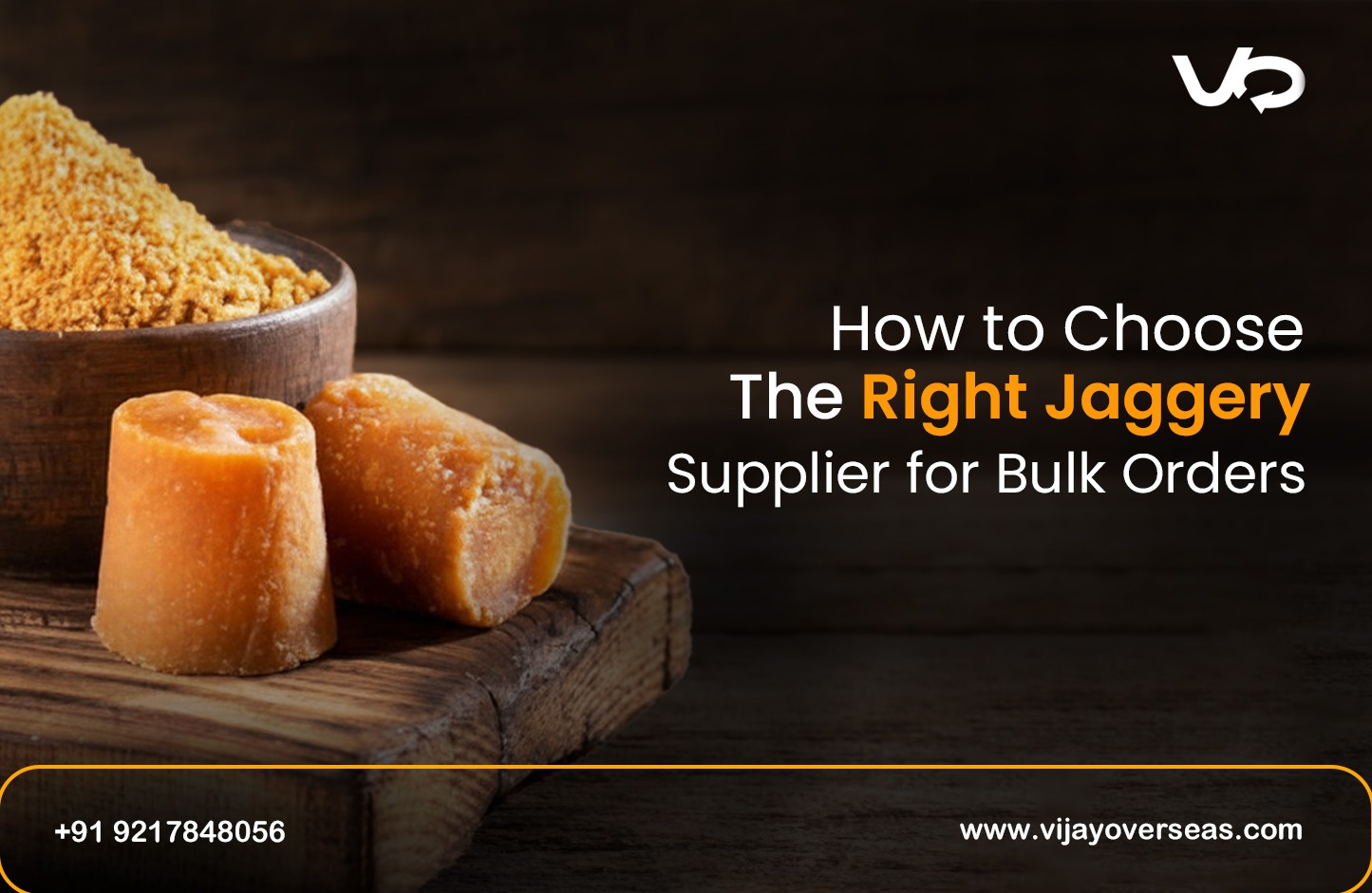
  • How to Choose the Right Jaggery Supplier for Bulk Orders

    How to Choose the Right Jaggery Supplier for Bulk Orders

    With increasing requirement and preference for natural and clean label sweeteners around the world, walling of jaggery in place of existing sugars by food manufactures/ importers/bulk buyers is getting established. But the quality, taste and sustainability of jaggery largely depends on the supplier. Choosing the perfect jaggery bulk supplier isn’t just a buying decision, it’s partnership–one that affects your product quality, brand image and supply chain predictability.

    This blog lists the factors that a Jaggery buyer from overseas needs to look at before selecting its supplier for large scale purchasing.

    Understand the Supplier’s Production Process

    Here are a few key factors to consider while buying jaggery. All jaggery is not created equally.

    Traditional vs Modern Production

    Traditional kolhu systems are still used by small-scale producers, who may use pesticides for clarifying boiled sugarcane juice to remove impurities. This style is passed down through the generation and not always consistent nor scalable.

    Nowadays, the crusher (kalesar)plants are high yielding; efficient jaggery producing plants where–

    • Water is also used to remove impurities.
    • Controlled heating ensures uniform quality
    • Environmental impact is significantly reduced

    Modern production also ensures a uniformly quality product, better hygiene and at the same time sustainable production, all factors necessary for export markets.

    Verify Product Quality and Consistency

    Consistency is key when ordering jaggery in bulk. Differences in colour, texture or aroma may interfere with food processing and influence the performance of final product.

    You should be able to get the following from a good vendor:

    • Uniform colour and grain structure
    • Stable sweetness and aroma profiles
    • Batch-to-batch consistency

    Ask for product samples and test out their products under the application you intend to use them in prior to placing large quantities.

    Check Sustainability and Environmental Practices

    Global shopping decisions are being affected by sustainability more and more. The current buyer is supposed to be responsible for sourcing — not just competitive in the market.

    Evaluate whether the supplier:

    • Uses energy-efficient processing systems
    • Minimizes water wastage
    • Avoids harmful chemical additives
    • Actively reduces air pollution

    Sustainable suppliers using the most efficient crusher plants align with global sustainability expectations and corporate responsibility goals.

    Evaluate Food Safety and Compliance Criteria

    To be used in international trade, food safety standards have to satisfy. A specialist in supplying jaggery must be prepared to satisfy global conditions as well.

    Look for:

    • Hygienic processing environments
    • Clear quality control protocols
    • Proper documentation and export readiness

    Suppliers familiar with the import/export process help to reduce risks…of all forms arising from legal & compliance issues, and shipping delays.

    Evaluate Scalability and Supply Reliability

    Bulk buyers want to know that the supplier can do large and follow up orders without sacrificing quality.

    Key questions to consider:

    • Can the supplier ramp up production in times of peak demand?
    • Hey, do they have the necessary sourcing power?
    • Can they lock-up long-term contracts though?

    Strong sugarcane ecosystem in India Reliable suppliers can ensure a steady supply, if the infrastructure is are there.

    Packaging and Logistics Capabilities

    Bulk orders of jaggery need good quality packing to maintain the hygiene and longevity of the product in storage and transit conditions.

    A dependable supplier should offer:

    • Export-grade bulk packaging options
    • Moisture-resistant and contamination-safe packing
    • Delivery both in home and abroad with logistics support

    Well-packaged and efficiently shipped (to avoid pilferage) to minimize product loss with jaggery reaching the buyers in sound condition.

    Transparency and Traceability

    Hiddenness is less and less what global buyers are after in their sourcing.” And knowing where and how the product is made establishes trust and supports long-term relationships.

    Choose suppliers who can provide:

    • Clear sourcing information
    • One hundred percent of the traceability from sugarcane procurement to final product
    • Transparency with lessons learned and with scheduling

    Transparency is the sign of a professional and quality oriented service.

    Experience of Export and Wholesale Business

    Export experienced suppliers know the nuances of bulk trading such as documentation, timelines and quality standards.

    An experienced jaggery exporter can:

    • Anticipate potential challenges
    • Propose solutions specifically aimed at foreign purchasers
    • Maintain consistency across shipments

    It’s a priceless experience for organizations wanting dependable sourcing for the long term.

    Why Vijay Overseas is your best choice for volumes of jaggery?

    We at Vijay Overseas are the leading suppliers of high quality jaggery for bulk and export market. Our jaggery is produced in advanced crusher (kalesar) plants that remove impurities by vapor substances – no chemical clarifiers are used.

    Our approach ensures:

    • Consistent quality across large volumes
    • Environmentally responsible production
    • Reliable supply for global buyers

    We know exactly what the international markets want and hence work with our partner farmers at doorstep to provide quality and sustainable jaggery.

    Conclusion

    Selecting the right source of jaggery for bulk supply is not easy, as production techniques, consistent quality sustainability practices and supply dependability have to be studied impersonally. A reliable vendor is not just a delivery of product—they are invested in their growth too.

    With the worldwide demand for natural sweeteners on the rise, maintaining consistent supply through a reliable and experienced jaggery supplier is the key to long-term success and brand authenticity.

    If it is a dependable jaggery exporter for bulk or export order you searching, partner with Vijay Overseas.

    👉 Visit www.vijayoverseas.com

    📩 Enquire with our team today to find out more about how we can supply you in bigger quantities, samples and sourcing long term

  • Why Global Buyers Are Shifting to Indian Jaggery

    Why Global Buyers Are Shifting to Indian Jaggery

    Buyer desires are more folly as a result of changing tastes. Markets today are no longer price driven as they used to be in the past. Instead, purchasing decisions are being formulated on the basis of quality, sustainability, traceability and authenticity. Therefore, to satisfy the global demand, buyers are also replacing cane sugar with Indian jaggery as this is a natural and ethical swap.

    From the traditional village-based jaggery of years gone by, we’ve come all the way to India’s organic Jaggery now being recognized and sought after across the world for its raw purity, ease of use and how much sense it makes in terms of modern food values.

    Increasing Concerns Toward Natural and Clean-Label Sweeteners on a Global Level

    Internationally, food consumers are paying more attention to what goes into their food. This has resulted in an increasing inclination for:

    • Minimally processed ingredients
    • Naturally derived sweeteners
    • Clean-label products with simple compositions

    Highly processed sugar is coming under assault. Jaggery, however, is the product of cane juice, and far less processing. It makes it a compelling option for those outside the U.S. who are serving consumers that are health-conscious and ingredient-aware.

    Legacy and Expertise of India in Jaggery Manufacturing

    India is the largest producer of sugarcane in the world and jaggery has been part of Indian food cultural history for millennia. This long-standing knowledge gives Indian growers a special advantage.

    For generations, producers have refined the methods of harvesting, boiling and concentrating sugarcane juice for best flavor and texture. This traditional wisdom is now augmented by modern process technologies and the Indian jaggery can match international norms.

    Shift Toward Sustainable Production Methods

    Sustainability is no longer a choice for universal buyers—it is an obligation. Among the main reasons of buyers for preferring Indian jaggery: implementation of modern and eco-efficient production systems.

    Traditional vs Modern Processing

    Traditional kolhu methods are (or were) mostly at a small/intermediate and hence less controlled scale, where chemicals (e.g., for removing impurities) could be used, however modern crusher (kalesar) plants usually employ:

    • Water vapour-based clarification
    • Controlled heating systems
    • Efficient fuel usage

    These methods significantly reduce:

    • Water wastage
    • Air pollution
    • Chemical dependency

    While jaggery made from modern plants is, therefore, more uniform and environmentally responsible, it also offers potential for sustainable sourcing for some global brands and importers.

    Uniformity and Quality Assurance for Export Requirements

    For foreign buyers, uniformity is more important than ever. Even small differences in color, texture, or flavor may impact product formulations and consumer confidence.

    These third world Indian jaggery makers with modern infrastructure can export:

    • Uniform colour and grain structure
    • Stable aroma and flavour profiles
    • Reliable quality across large volumes

    This reliability and consistency enables international buyers to easily incorporate jaggery from India into their sourcing operations.

    Versatility Across Global Food Applications

    The use of Indian jaggery has spread to a global market with various origins.

    • Bakery and confectionery
    • Beverages and syrups
    • Ethnic and fusion cuisines
    • Artisanal and specialty food products

    Its deeply caramel-like notes and natural sweetness work well in traditional applications as well as innovative products. This dynamic makes it attractive for foreign-based producers and chefs.

    Competitive Supply and Scalability

    India has a massive production and processing capacity of sugarcane which helps the sugar mills to cater for huge export orders. Global buyers benefit from:

    • Reliable seasonal availability
    • Ability to fulfill large-volume orders
    • Competitive pricing without compromising quality

    This scalability is especially beneficial for importers and food companies seeking a longer-term sourcing relationship.

    Adherence to Internationally Accepted Levels of Transparency and Traceability

    Overseas buyers have been proving to be increasingly insistent on knowing how and where products are sourced and produced. And Indian jaggery exporters are now better placed to offer:

    • Clear documentation
    • Farm to plant traceability
    • Compliant with the international food safety standards

    This instils confidence between the buyer and seller and also cultivates long-term trading relationships.

    Vijay Overseas: Meeting The Demand for Jaggery Globally Through A Socially Responsible Process

    Vijay Overseas is where we blend the centuries-old tradition of jaggery making in India with state-of-the-art sustainable production practices. We have sugar making plants designed in accordance with the most advanced techniques of crystal extraction.Our jaggery plants use the latest technologies and are thoroughly quality tested – our jaggery plant also uses the efficient approach of coarse, which ensures there is no need for chemical clarifiers and eliminates pollution.

    This approach ensures:

    • Consistent quality
    • Reduced environmental impact
    • Export Quality Jaggery – Passed for World Export

    We are committed to offering high-quality purity, reliability and sustainability at buyers locations around world.

    Conclusion

    International purchasers are turning towards Indian jaggery as this is just the right amalgamation of traditional and contemporary. Because of these inherent goodness, Indian jaggery is poised to be the natural sweetener and an alternative of choice for people around the world with its natural, sustainable & eco- friendly production processes that ensure consistent quality products and robust export capacity.

    With consumers’ preference for ethical supply chains and responsible purchasing increasing, Indian jaggery is one product that fulfils both conscientious and commercial objectives.

    If you’re a world litterateur, importer or food producer in search of top-tier Indian jaggery that is sustainably produced.oplevel black sesame seeds, contact Vijay Overseas today!

    👉 Visit www.vijayoverseas.com

    📩 Contact for bulk orders, export enquiries and long-term sourcing relationships

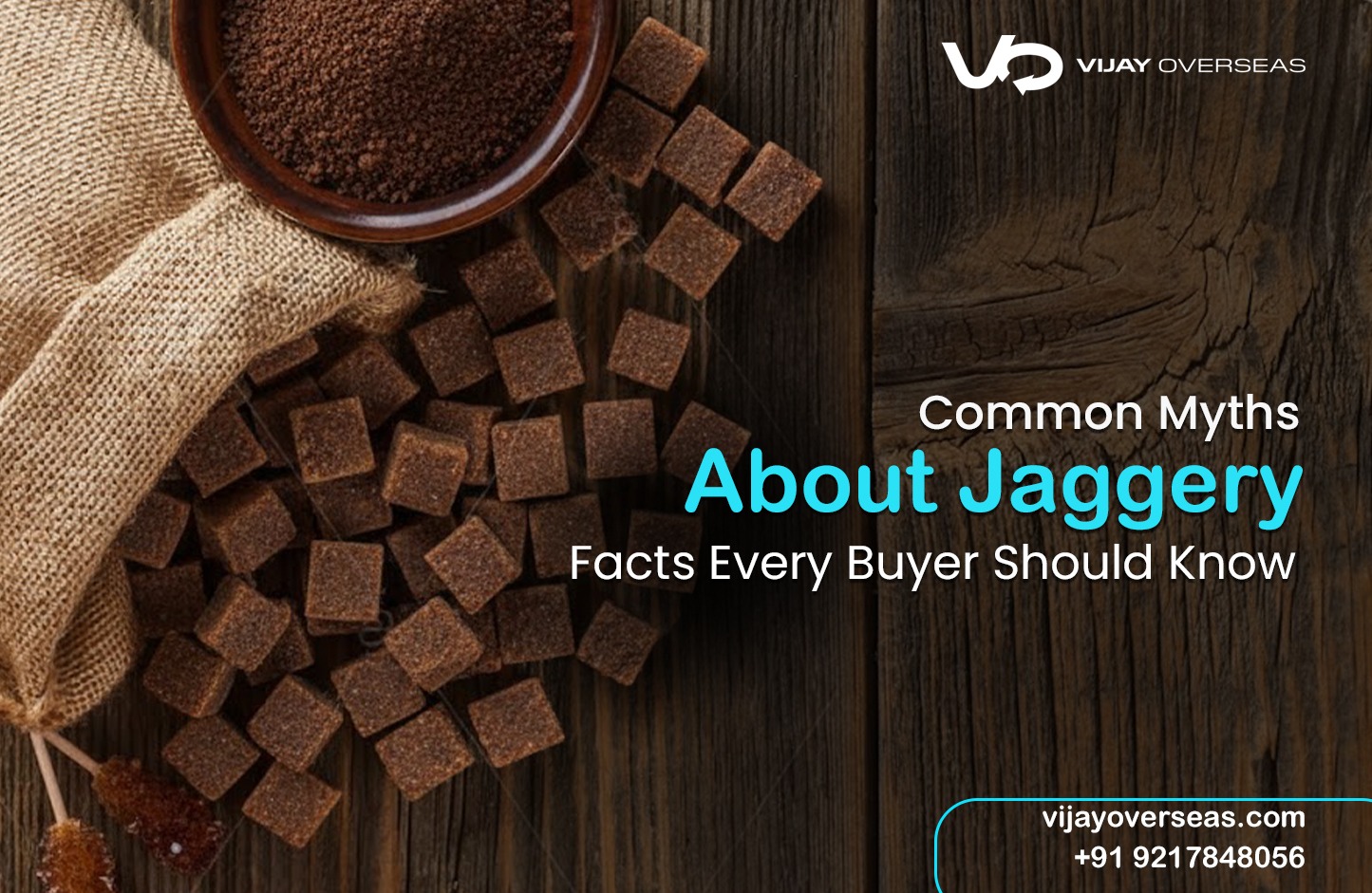
  • Common Myths About Jaggery — Facts Every Buyer Should Know

    Common Myths About Jaggery — Facts Every Buyer Should Know

    Jaggery is traditional sweetener used for centuries, but one that is often sorely misunderstood— particularly in current trade and the global market. A lot of misinformation about jaggery is spread without having much clue about how each the methods of production, processing and resulting quality work.

    For purchasers, importers and food producers alike it’s critical to separate fact from fiction in order to make educated sourcing decisions. Pay no attention to these nonsense, and here is what buyers should actually know.

    Myth 1: The Darker The Jaggery, The Better Its Quality

    Fact:

    Colour is not an indication of whether jaggery is good or bad.

    Unadulterated jaggery varies from golden brown to dark brown in color, depending on how it is prepared:

    • Sugarcane variety
    • Harvest timing
    • Clarification method
    • Processing temperature

    There is a dark jaggery, which is colour because it has been processed with sugar; The bubbles in sugarcane polyphenol are not black or those from gur – another indication of unnatural treatment. Quality is to be judged by consistency, aroma, texture and production method – not colour.

    Myth 2: Jaggery Is Naturally Chemical-Free All jaggery is chemical-free by default.

    Fact:

    Jaggery isn’t necessarily non-chemical in all cases.

    Chemical clarifiers are widely used in most of these traditional kolhu units to clean impurities from the boiling sugarcane juice. Although this practice is common, it’s widely misunderstood and thought of as natural.

    New jaggery plants are no longer called for to use animal-derived, water clarification ought to properly be executed, after that the mere fact that it does not have taste changers needs to suffice. Ask buyers for how the clarification process occurs, not just what it is when completed.

    Myth 3:Conventional Jaggery Is Sustainable Always

    Fact:

    Traditional is not the same as sustainable.

    Small-scale kolhu methods often involve:

    • High water consumption
    • Gunshots being fired stirring up air pollution
    • Limited waste and emission control

    They may be of interest culturally, but very few can become sustainable at scale. In comparison, contemporary (kalesar) crusher plants are built to minimize water waste and smoke thus they can sustain responsible long term production.

    Myth 4: The texture of jaggery does not matter.

    Fact:

    Texture is the primary attribute of quality.

    High-quality jaggery should have:

    • Hard and brittle in texture (hard jaggery)
    • Smooth surface without excess stickiness
    • Uniform granulation (jaggery powder)

    Uneven texture might indicate improper boiling, unbalanced moisture or inadequate storage. In export markets, texture has a direct impact on shelf life, packing efficiency and transportability.

    Myth 5: All jaggery has the same flavour.

    Fact:

    Flavor is any different according to source and treatment.

    Jaggery’s flavor profile depends upon:

    • Sugarcane origin
    • Processing temperature
    • Concentration method

    True jaggery tastes subtly of caramel, with some background notes of really sugary sugar cane – it is not an intensely sweet or insipid sweetness. Any difference in taste from batch to batch can signal that processing was not uniform, a situation importers want to avoid.

    Myth 6: Jaggery doesn’t need quality control.

    Fact:

    Export-quality jaggery requires strict consistency.

    International buyers expect:

    • Uniform colour and texture
    • Repeatable taste profiles
    • Stable moisture levels
    • Hygienic packaging

    If over-boiled without proper control of the cooking process, jaggery can separate out to a crystalline form. This is why professional export houses do not depend solely on human judgment but rather invest into standardised processes and tracking systems.

    Myth 7: Jaggery Is a Local or Ethnic Product Only

    Fact:

    Jaggery has growing global demand.

    With rising interest in:

    • Natural sweeteners
    • Clean-label ingredients
    • Traditional food products

    International food brands, bakeries and specialty retailers have embraced jaggery. Maintaining that quality and consistency is what has allowed jaggery to go from local markets to international shelves.

    What Every Buyer Really Needs to Know

    Rather than going off of guesses, what buyers should be focused on:

    • Method of production (chemical or vapour clarification)
    • Consistency across batches
    • Texture and aroma
    • Packaging and storage standards
    • Supplier transparency

    More”Certainly are truths that demystify and more accurately reflect true wine quality than myth or visual appearance, and indeed tasting your wine.

    Vijay Overseas’ Commitment to Transparency

    The team at Vijay Overseas feels informed buyers; are better business partners. Our jaggery is handmade by advanced, efficient methods that value:

    • Vapour-based impurity removal
    • Controlled boiling and concentration
    • Less water and air pollution
    • Reliable quality for both domestic and export market

    We are committed to reliability, sustainability, and transparency at every step of the way.

    Conclusion

    It’s a humble product but the quality of jaggery hinges on a host of complex factors — from processing techniques to uniformity control. We can have confidence that by setting aside popular myths and instead concentrating on the facts we know to be accurate, buyers will make responsible choices for sourcing.

    Clear knowledge about jaggery is the initial building block of trust in long term supplier relationships.

    For more details on Vijay Overseas and our eco-friendly, chemical-free jaggery or exporting services here:

    👉 www.vijayoverseas.com

    For wholesale supply, export inquiries or collaborations, we invite to you reach out to us.

  • Understanding the Colour, Texture & Aroma of Pure Jaggery

    Understanding the Colour, Texture & Aroma of Pure Jaggery

    Jaggery is not just a sweetener, it embodies its origin, method of preparation and purity. The colour,appearance and texture of jaggery can differ depending on the source of the sugar cane. Good quality jaggery should have a pleasant smell without any additives.Jaggery are more preferred by health-conscious people because it is not considered as highly processed as white sugar. These qualities make it easy to tell apart genuine, good quality jaggery from its impure or excessively processed counterpart.

    Since better choices are made when well-informed, At Vijay Overseas we feel that the transparency should start with educating people of how real good quality jaggery looks like. This guide dissects the three most critical sensory characteristics of pure jaggery and what they tell you about its making.

    Pure Jaggery Colour and what it tells us?

    The colour of jaggery is one of the initial things that a person would notice and it contains very useful information regarding the manner in which the jaggery was made.

    Natural Colour Range

    The pure jaggery generally comes in the colours of:

    • Golden brown
    • Light amber
    • Deep brown

    These differences can be based on, for example:

    • Sugarcane variety
    • Harvest season
    • Climatic conditions
    • Clarification method used during processing

    One thing to note is that unadulterated jaggery is not white or unnaturally bright. If colours are very pale or solid but not natural looking, it could be over processed or chemically treated.

    Why Colour Consistency Matters

    On the export side, color from lot to lot is critical. Small variations are tolerable as far as natural variation is concerned, but large ones can question the process control.

    Contemporary controlled production methods including vapour based clarifying, allows Achieving balanced and reproducible coloration without the need for chemical additions. This is one of the reasons that globally buyers prefer sustainably produced jaggery.

    Pure Jaggery’s Texture: Quality You Can Feel

    Texture is also the first direct property with a link to processing quality, moisture management and storage conditions.

    Ideal Texture Characteristics

    High-quality jaggery generally has:

    • Unlike gur, sugar and other sweeteners, the jaggery, we supply is hard in texture but brittle in nature.
    • A smooth, non-sticky surface
    • Even granulation (for jaggery powder)

    Excessive stickiness can suggest:

    • High moisture content
    • Improper boiling or concentration
    • Inadequate storage conditions

    On the flip side, if jaggery is too hard or crumbly it may have been overcooked or dehydrated.

    Texture and Export Standards

    For supply abroad, texture is a big factor in:

    • Shelf stability
    • Packaging performance
    • Ease of handling during transport

    Maintaining the perfect balance is key, and that’s where controlled production environments come in to play as jaggery does not contain preservatives.

    Pure Jaggery Smell: The Purest Sound of all burbling.

    Smell is one of the most distinctive but often unlike attributes of pure jaggery.

    What Pure Jaggery Smells Like

    Authentic jaggery has a:

    • Mild, warm, caramel-like aroma
    • Subtle sugarcane notes
    • Clean and pleasant fragrance

    It is a natural aroma that comes as the sugarcane juice is slowly concentrated.

    What to Watch Out For

    No smell or unusual smell may indicate:

    • Over-processing
    • Chemical clarification
    • Poor-quality raw material

    Real jaggery doesn’t require artificial flavor, the fragrance is from jaggery’s careful processing.

    How The Processing Affects Colour, Texture & Aroma of Coffee

    Method of clarification and concentration of sugarcane juice directly influences all three sensory factors.

    Traditional Kolhu Units

    In many traditional kolhu units:

    • Open boiling is used
    • Chemical clarifiers can be used to remove impurities too.
    • Water usage is high
    • The environment is compromised when filled with smoke and emissions.

    Although these approaches are conventional, they tend to lack regularity and operation at scale.

    Modern Crusher (Kalesar) Plants

    Modern jaggery plants use:

    • Kalesar, efficient crushers for getting juice
    • Vapour phase clarification using water vapour for impurities removal
    • Controlled boiling temperatures
    • Less water and air pollution

    With this method, you get a better handle on color, texture, and fragrance — it also encourages sustainable production.

    Why These Traits Are Important To Global Buyers

    For global markets, taste is not the only criterion for jaggery. Buyers evaluate:

    • Visual appearance (colour)
    • Physical stability (texture)
    • Sensory authenticity (aroma)

    What is required: – Consistency between shipments is a must for the following:

    • Food manufacturers
    • Retail brands
    • Bulk ingredient buyers

    Trusted Jaggery Suppliers are known to use systems that secure repeatability, without resort even a bit on natural integrity.

    Quality Jaggery by Vijay Overseas

    We at Vijay Overseas make Jaggery, our jaggery is manufactured in hygienic conditions with the use of modern machinery and sophisticated technology.Jaggery produced by boiling concentrated sugarcane juice and it is compacted and wrapped to form a solid that can then be sold to consumers.

    Our focus includes:

    • Vapour phase impurity scavenging instead of chemical scavenge uptake
    • Produced under strict controls for colour and texture uniformity
    • Hygienic handling and packaging
    • Sustainability-driven operations

    When we prioritize process integrity, the jaggery we provide will be pure – not uniformly artificial.

    Conclusion

    The colour, texture and aroma of jaggery are more than sensory qualities—they reveal how responsibly and cautiously the product was produced. This is the story of pure jaggery, it imparts its origin and processing method and how much concern is exercised while making it.

    As there is increasing international interest in natural sweeteners, knowledge of these properties becomes important to enable us to make informed decisions.

    To know more about Vijay Overseas- our socially responsible chemical free jaggery and also export friendly nature, check out :

    👉 www.vijayoverseas.com

    For bulk orders, exports and collaborative opportunities, we would love to hear from you.

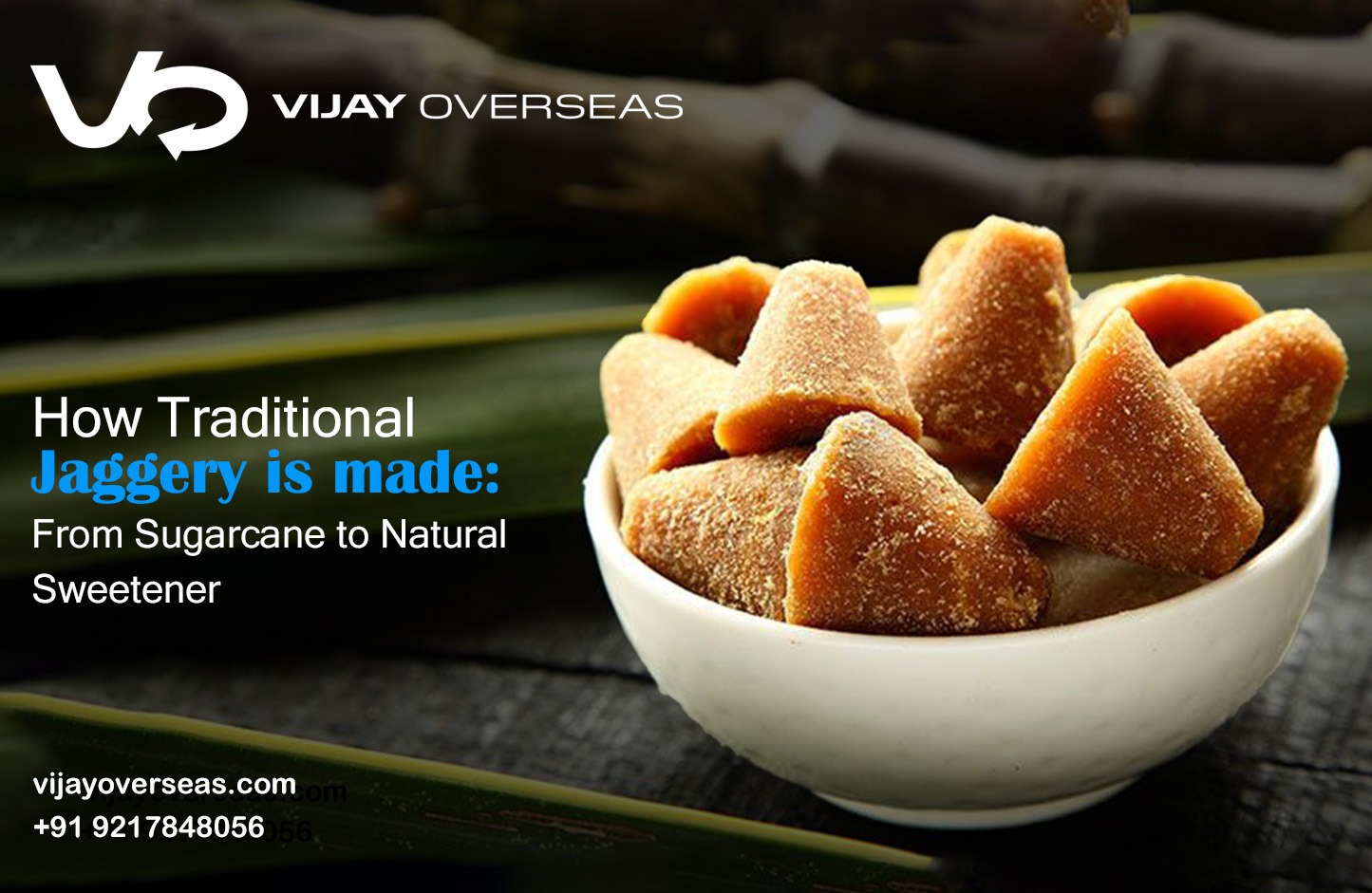
  • How Traditional Jaggery Is Made: From Sugarcane to Natural Sweetener

    How Traditional Jaggery Is Made: From Sugarcane to Natural Sweetener

    A traditional natural sweetener made by concentrating sugar can juice, jaggery has been used for long in Indian cooking. Before white sugar overtook the world, jaggery was made in simple, traditional ways that honoured nature, time and skill. Even now to-days traditional jaggery  is still in vogue because of its genuineness, flavor and cultural aspects.

    And when we know how traditional jaggery is made — from sugarcane to natural sweetener, it can be a source of pride for buyers and consumers as well as global importers who are willing to pay top dollars for the pure stuff. Unlike the industrial production of sugar, jaggery-making takes a slower, more natural path that conserves what you love about sugarcane.

    1. Harvesting Fresh Sugarcane

    The process of making jaggery begins in the sugarcane fields themselves. Perfectly ripe sugarcane is harvested at the right time for maximum juice content and natural sweetness.

    Freshness is critical. Sugar cane is normally processed soon after it is harvested to minimize fermentation and maintain quality. This kind of instant processing is one of the reasons why traditional jaggery retains its aroma and flavour.

    1. Crushing the Sugarcane

    After the sugarcane is harvested, it is washed and pressed to obtain juice. In the olden days, they used the most basic of equipment – mechanical crushers run by electricity or diesel, but ancient extraction techniques were still practised.

    The extracted sugarcane juice is:

    • Greenish in colour
    • Rich in natural sugars
    • Loaded with plant based impurities waiting to be clarified

    It is this raw juice, the Aakaljuice that forms the base of pure jaggery.

    1. Natural Clarification of Sugarcane Juice

    Clarification is a most important step in the production of traditional jaggery.

    The juice becomes clarified using both the chemical and natural clarification process.The traditional way of clarifying the jaggery is an honest, long procedure that does not involve any chemical agents. Plant based materials and natural settling methods assist in the removal of contaminants such as dust, fibres and soil particles.

    This step ensures:

    • Cleaner juice
    • Better taste
    • No chemical residues

    Foam and impurities rising to the surface are skimmed off manually, making the operation simple and open.

    1. Slow Boiling in Open Pans

    The clarified sugarcane juice is then poured into large, open iron pans. The juice is then gently boiled down by means of controlled heat.

    This long, slow simmering is essential as:

    • It also removes cold moisture, which can help to prevent bacteria and mould from developing.
    • It thickens the juice gradually
    • It acquires a typical brown color and pungent smell.

    There are no shortcuts for cane that’s being made into safe sugar instead of industrial sugar. This will take a few hours depending the amount of magnets and temperature.

    1. Concentration and Consistency Check

    The juice becomes thicker and darker as it continues to boil. Highly skilled workers keep a close eye on the texture, temperature and consistency.

    Experience tells when this second stage is reached—when the liquid becomes a thick syrup that will harden on cooling. It is this judgment that has a direct impact upon:

    • Texture
    • Shelf stability
    • Final product quality

    Processes for jaggery-making have low level of automation and are based on human skills.

    1. Moulding and Shaping

    When you have reached the desired consistency, take the thick jaggery syrup off heat and pour it into containers.

    Jaggery can be formed into: According to use and demand, jaggery is made in the form of:

    • Blocks
    • Cubes
    • Balls
    • Slabs

    This semi solid mass is then cooled and crushed to form jaggery powder.

    By now the jaggery is hardening up naturally without agents.

    1. Cooling and Natural Hardening

    The moulded jaggery is cooled at ambient temperature. It cools, gets solid and forms the max structure.

    In conventional methods, there exists no artificial cooling or chemical hardening agents. Natural cooling ensures:

    • Stable texture
    • Authentic taste
    • Retention of sugarcane character

    The jaggery is ready for packing after it fully cools down.

    1. Sorting, Quality Checks, and Packaging

    Jaggery blocks or powder are closely examined before packaging. Specifications Traditional producers and exporters look for:

    • Uniformity
    • Absence of foreign matter
    • Proper hardness or granulation
    • Moisture levels

    Hygienic packaging becomes very crucial when it is intended for exports or bulk supply to prevent the jaggery from moisture and adulteration.

    Contemporary exporters now marry both traditional manufacturing, with modern quality monitoring and packaging standards to ensure that the world outside Tanzania receives what it has come to expect.

    1. Jaggery of the Bygone Era and Its Significance Today

    Even with all these technology, the traditional jaggery continues to be popular due to:

    • Minimal processing
    • Absence of chemicals
    • Authentic flavour
    • Cultural and culinary importance

    Natural & Clean Label: With naturalness and clean label top of mind for global customers, traditionally-made jaggery is the ideal ingredient across many markets.

    Vijay Overseas and Conventional Jaggery Manufacture

    We source from reliable farmers who adhere to traditional chemical free jaggery making methods as well as meet strict modern hygiene and export norms.

    Our focus includes:

    • Sustainably sourced sugarcane
    • Traditional boiling and processing methods
    • No artificial additives or preservatives
    • Generational continuity of quality for domestic and export market.

    We take pride in our tradition and we take pride in providing the best jaggery both culturally and commercially.

    Conclusion

    Translating pappanchatti jaggery making is serendipity of nature, time and experience. From the fresh cane to slow boiling and natural molding, each process is exactly right for the genuine article.

    Learning about the process can help buyers appreciate why old-fashioned jaggery differs from mechanized varieties, and how demand for this sweetener remains in markets worldwide.

    🌿 On the lookout for naturally prepared, chemical-free jaggery?

    Visit 👉 www.vijayoverseas.com

    Or, explore our jaggery range, discover our sourcing, get in touch for bulk supply and export queries.